
Every guide to cinematic AI video prompting teaches the same vocabulary: dolly in, crane up, rack focus, whip pan. Key light, fill, rim. It is the language of a film set, and it sounds like the right thing to write.
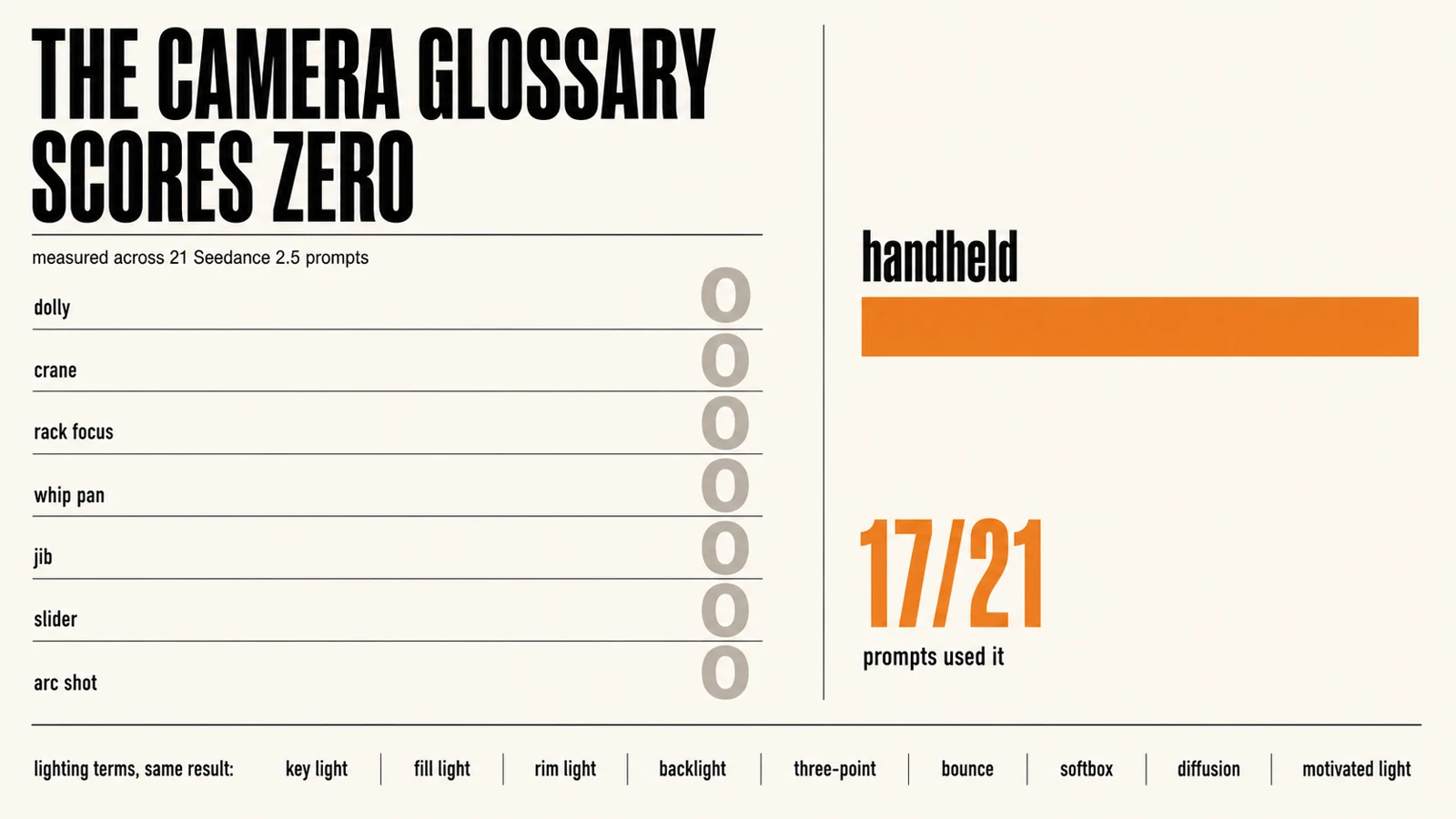
We measured 21 published Seedance 2.5 prompts — real ones, each with the video it produced. Across all of them, dolly appears zero times. So does crane. So does rack focus. So does every term in the lighting department's vocabulary.
Something else is doing the work instead. This is what it is.
The vocabulary that isn't there
The corpus is 21 community prompts collected with their result videos. Ten were taken apart in our guide to prompting Seedance 2.5; the five studied below have not been published before. Counts are whole-word matches across all 21.
Camera movement — the textbook list:
| Term | Occurrences | Prompts using it |
|---|---|---|
dolly | 0 | 0 / 21 |
crane | 0 | 0 / 21 |
rack focus / pull focus | 0 | 0 / 21 |
whip pan | 0 | 0 / 21 |
jib | 0 | 0 / 21 |
slider | 0 | 0 / 21 |
trucking | 0 | 0 / 21 |
arc shot | 0 | 0 / 21 |
dutch angle | 0 | 0 / 21 |
push-in | 2 | 2 / 21 |
Lighting — the department's list:
| Term | Occurrences | Prompts using it |
|---|---|---|
key light | 0 | 0 / 21 |
fill light | 0 | 0 / 21 |
rim light | 0 | 0 / 21 |
backlight | 0 | 0 / 21 |
three-point | 0 | 0 / 21 |
bounce | 0 | 0 / 21 |
softbox | 0 | 0 / 21 |
diffusion | 0 | 0 / 21 |
motivated light | 0 | 0 / 21 |
Two complete glossaries, and one hit between them.
Now the words that are actually there:
| Term | Occurrences | Prompts using it |
|---|---|---|
handheld | 39 | 17 / 21 |
close-up | 13 | 10 / 21 |
sunlight | 9 | 8 / 21 |
tracking | 13 | 7 / 21 |
grain | 10 | 7 / 21 |
medium shot | 7 | 6 / 21 |
motion blur | 7 | 6 / 21 |
neon | 6 | 5 / 21 |
follow | 16 | 5 / 21 |
shallow depth | 4 | 4 / 21 |
macro | 4 | 4 / 21 |
window light | 3 | 3 / 21 |
Sorted into groups, four things are being described — and film-set jargon is not one of them:
- How the camera behaves —
handheld,follow,tracking - Where the frame sits —
close-up,medium shot,macro,low-angle - What the image is made of —
grain,motion blur,shallow depth - What is emitting the light —
sunlight,neon,window light
Take those four in turn and you have a working method.
Camera feel beats camera moves
handheld appears in 17 of 21 prompts — more than every other camera term put together. It is not describing a move. It is describing a relationship between the camera and a human being.
Left alone, Seedance 2.5 produces a gliding, weightless drift that reads as synthetic within a second. It is the single most recognisable tell of generated video. handheld is the cheapest available fix, which is why nearly everyone who has spent time with the model writes it.
But look at how the good prompts qualify it. They rarely stop at the word:
shoulder-mounted handheld camera with imperfect human movementextremely raw handheld flip-camera footage with heavy camera shake, natural reframing, partial face crops, focus huntingsubtle handheld camera energyslightly shaky like a friend filming
Each of these answers a different question: who is holding it, and how well? A shoulder mount is steady and professional. A flip camera held at arm's length is not. "A friend filming" carries an entire posture with it. The word handheld sets the category; the qualifier sets the amount.
This is the first substitution. Where a film crew would specify a piece of equipment — Steadicam, gimbal, shoulder rig — a working Seedance prompt specifies the operator's competence and intent. The model has seen far more footage labelled by who shot it than by what it was shot on.
Framing survives; movement doesn't
Here is the split that makes the zero-scores make sense. The framing vocabulary is alive and well: close-up in 10 of 21 prompts, medium shot in 6, macro in 4, extreme close-up in 3, low-angle and POV in 2 each.
So it is not that film vocabulary fails. It is that static vocabulary works and kinetic vocabulary doesn't.
A close-up is a description of a single frame. You can point at it in any still. A dolly-in is a description of change across time, expressed as an instruction to a piece of hardware that the model has never had to operate. One is a label on an image; the other is a job order for a grip.
The practical consequence is that you should keep every framing word you know and throw away every movement word. Then describe the movement a different way.
How to write a move without the glossary
The prompts that do direct camera movement do it in one of two ways.
By naming the geometry, not the rig. This is the roller-coaster piece by @techhalla — a freeze-time gag where everything on the ride locks in place except one bored passenger:
Its camera direction is bracketed at the head of each beat:
0-5s: [Medium Shot] ...
5-9s: [Dynamic Tracking] ...
9-15s: [Slow Orbital + Detail] Camera slowly orbits the frozen cars.
15-20s: [Medium Close-up] ...
20-26s: [Tight Medium] ...
26-30s: [Medium Shot] ...
Slow Orbital is not a rig. It is a shape — the camera goes around the subject, slowly. It is followed immediately by the plain-English restatement, "Camera slowly orbits the frozen cars," which is the part that actually carries. In the result, the freeze and the selective motion land cleanly; the orbit reads as a slow drift around the car rather than a full arc. Worth knowing: geometry gets you the direction of a move, not its magnitude.
Note what else this prompt does. Six beats, six framings, and not one of them is a movement term borrowed from a set. Dynamic Tracking is the only other move in the piece, and tracking is one of the words that survives — because it describes a relationship to the subject (the camera goes where the subject goes), not a mechanism.
Full prompt (2,797 characters)
Photorealistic cinematic daytime amusement park roller coaster, bright hard sunlight, strong wind, realistic motion blur on tracks and background, subtle handheld camera energy, rich skin detail, heavy natural film grain.

0-5s: [Medium Shot] A young woman in her early 20s sits in the front seat of a moving roller coaster car, calm and slightly bored, hair whipping in the wind. Beside her sits a middle-aged man wearing what looks like a normal full head of hair. Behind them, another car with a woman is visible. The coaster drops and banks hard.

5-9s: [Dynamic Tracking] The force of the turn rips the man’s wig free. It peels off his bald head in a chaotic upward arc, spinning and flying backward through the air. The wig lands messily on the head of the woman in the car behind. Everyone’s faces freeze in pure shock and confusion at the peak of the chaos. Time locks completely. Only the young woman in the front keeps moving.

9-15s: [Slow Orbital + Detail] Camera slowly orbits the frozen cars. The wig hangs mid-air in a twisted shape with individual hairs suspended. The bald man’s scalp is fully exposed, mouth open. The woman behind is frozen mid-scream with the wig draped over her face. The young woman looks sideways, rolls her eyes and mouths “joder, otra vez”. She reaches into her pocket, pulls out a stick of chewing gum, unwraps it and calmly puts it in her mouth, starting to chew while the entire frozen scene (except her) begins a precise reverse.

15-20s: [Medium Close-up] The rewind is controlled and elegant: the wig lifts off the woman behind, flies backward through the air in reverse, and returns exactly to the moment it is only beginning to peel off the bald man’s head. Time freezes again at that precise instant — the front edge of the wig just lifting, a few strands already loose.

20-26s: [Tight Medium] Still frozen for everyone else, the young woman takes the chewed gum out of her mouth, reaches over and firmly presses it onto the center of the bald man’s scalp, right under the lifting wig. With the same hand she smooths and presses the wig back down into perfect place, locking it with the gum. She sits back, looks straight ahead with a tiny private smile, completely unbothered.

26-30s: [Medium Shot] Time suddenly resumes at full real-time speed. The coaster continues its drop. The man touches his head, feels the wig still firmly in place, looks confused for a second, then breaks into a relieved, happy smile. The young woman stares forward, already chewing a new piece of gum, expression of quiet satisfaction.

Photorealistic, ultra-detailed wind and hair physics, perfect motion blur only on moving elements, stable characters, cinematic lighting, heavy natural film grain, no artifacts, movie-level temporal coherence, high rewatch value.
By naming what the camera is reacting to. The second method is subtler and, in the pieces that feel most alive, more effective. Instead of directing the camera, you give it something to respond to:
The camera subtly adjusts to avoid the cat, creating an authentic human reaction.
the handheld camera hesitates for a second before slowly following behind
Both are from the same prompt, and neither names a move. They name a cause. The camera moves because something happened in front of it — which is how camera movement works on a real documentary shoot, and evidently how the model has learned it.
Body, lens and stock: naming the capture format
Naming actual equipment is rarer than the guides suggest. In the whole corpus, ARRI appears in 2 prompts of 21, Cooke in 2, anamorphic in 2. It is a stylistic option, not a requirement.
What is common is naming the capture format — the medium the footage is pretending to have been recorded on. 16mm in 2 prompts, camcorder in 2, MiniDV in 1, Kodak in 1, smartphone in 2, flip-camera in 1. And underneath those, the texture words that describe what such a format does to an image: grain in 7 prompts, motion blur in 6, shallow depth in 4.
This matters because a format name is a compression scheme. 16mm Kodak implies grain structure, colour response, latitude, and a certain relationship to highlight roll-off, all at once. It is the single highest-leverage phrase available to you — when it lands.
Which brings us to the most useful thing in this whole corpus.
Why one period-look request landed and two didn't
Three prompts in the corpus ask for a specific vintage capture format. One got it. Two didn't. The three sit side by side below.
The one that landed
@hey_am_cherry asked for late-1970s Mediterranean documentary footage on 16mm Kodak:
The faded warm palette, the soft lens, the sun-bleached highlights, the unhurried follow — it all arrived. The prompt opens with this:
Style:
Authentic late-1970s Mediterranean documentary captured on vintage 16mm
Kodak film, naturally faded colors, subtle film grain, real optical
imperfections, slight gate weave, shoulder-mounted handheld camera with
imperfect human movement, soft vintage lenses, warm afternoon sunlight,
realistic skin texture, no cinematic polish, feels like forgotten
archival footage discovered decades later.
and — this is the part that matters — closes with the same instruction again, restated in different words:
Image Quality:
Ultra-photorealistic vintage documentary, authentic analog exposure,
realistic human motion, organic focus breathing, imperfect framing,
Kodak 16mm archival texture, subtle light leaks, soft highlight bloom,
natural skin pores, no AI smoothness, 4:3 aspect ratio.
Between the two blocks sit four timed beats of pure action. The look is stated, the story happens, the look is stated again.
Full prompt (2,213 characters)
Style:
Authentic late-1970s Mediterranean documentary captured on vintage 16mm Kodak film, naturally faded colors, subtle film grain, real optical imperfections, slight gate weave, shoulder-mounted handheld camera with imperfect human movement, soft vintage lenses, warm afternoon sunlight, realistic skin texture, no cinematic polish, feels like forgotten archival footage discovered decades later.

0–3 seconds:
A close handheld tracking shot follows a young woman in her 20s walking slowly through a narrow seaside alley lined with whitewashed houses, hanging linen curtains gently moving in the ocean breeze. She wears a simple linen dress, a woven shoulder bag, and naturally messy hair with no makeup. Instead of posing, she lightly brushes her fingertips across the textured walls while quietly observing everyday life around her.

3–7 seconds:
The camera naturally falls slightly behind her as she enters a tiny open courtyard where local people casually gather. An elderly man repairs a bicycle, someone waters colorful plants from a balcony above, laundry sways overhead, and a sleepy orange cat crosses directly in front of the lens. The camera subtly adjusts to avoid the cat, creating an authentic human reaction.

7–11 seconds:
A young child runs toward a rolling wooden toy that passes close to her feet. She instinctively bends down, catches it with one hand, smiles warmly, and hands it back without stopping her walk. The child laughs and runs away. No one performs for the camera; everything feels naturally observed.

11–15 seconds:
She reaches a small overlook facing the sparkling sea. Instead of stopping dramatically, she casually rests one elbow on an old stone railing while watching distant fishing boats. A gust of wind lifts loose strands of hair across her face. She gently moves them aside and continues walking out of frame as the handheld camera hesitates for a second before slowly following behind.

Image Quality:
Ultra-photorealistic vintage documentary, authentic analog exposure, realistic human motion, organic focus breathing, imperfect framing, Kodak 16mm archival texture, subtle light leaks, soft highlight bloom, natural skin pores, no AI smoothness, 4:3 aspect ratio.
One thing it asked for and did not get: 4:3 aspect ratio. The clip came back 9:16. Aspect ratio is a platform setting, not a prompt instruction — writing it costs you nothing but it will not override the dropdown.
The two that didn't
@doctorwasif asked for a DV tape camcorder look:
CAMERA:
DV 16mm tape camcorder handheld feel. ... Hand shake, misaligned
framing, delayed focus pulls, clumsy zooms, occasional face cut-off
framing, imperfect shots.
LOOK:
Soft, slightly blurry tape quality, faint tape noise, bloomed
highlights, flickering auto-exposure, muted contrast, realistic skin
tones ...
What came back is clean, modern, shallow-focus digital video. No tape noise, no bloom, no auto-exposure flicker. The requested capture format simply did not survive.
@saniaspeaks_ asked for a late-2000s flip camera, with an even longer list of imperfections:
Extremely raw handheld flip-camera footage with heavy camera shake,
natural reframing, partial face crops, focus hunting, exposure shifts,
warm faded colors, mild digital noise, and authentic home-video
imperfections. No posing, no cinematic glamour, no stabilization, no
modern color grading.
The result is a warm, well-exposed, thoroughly modern-looking selfie vlog. The handheld feel landed. The degradation did not.
What separates them
It is not word count — the flip-camera prompt lists more imperfections than the 16mm one does. Look instead at where the instruction sits.
| Prompt | Look stated at top | Look restated at bottom | Result |
|---|---|---|---|
| 16mm Kodak documentary | yes (Style:) | yes (Image Quality:) | landed |
| DV tape camcorder | yes (CAMERA: / LOOK:) | no | did not land |
| Flip camera | yes (opening paragraph) | no | did not land |
The one that worked is the one that said it twice — bracketing the story rather than prefacing it. Everything between the two statements is action; the look is the container.
Three cases is a hypothesis, not a law. But it is a cheap one to test: move a copy of your style block to the end of the prompt and generate again. If the look holds better, you have learned something about your own prompt for the cost of one run.
Two supporting observations make it more plausible. Degradation is being asked for against the model's grain — every optimisation in it pushes toward clean, stable, well-exposed frames, so an under-specified request for noise loses to that default. And in the successful prompt, the four beats between the bookends are pure action with no look words at all, so nothing in the body competes with the container. A style instruction has to survive everything written after it.
Light: name the source, never the fixture
Now the finding with the cleanest explanation behind it. Nine lighting-department terms, zero occurrences. Meanwhile:
| What is named | Prompts using it |
|---|---|
sunlight | 8 / 21 |
neon | 5 / 21 |
LED | 3 / 21 |
window light | 3 / 21 |
haze | 3 / 21 |
overcast | 2 / 21 |
practicals | 2 / 21 |
golden hour | 1 / 21 |
Every one of these is a thing that exists inside the scene. A window. A neon sign. The sun. An LED bar on a wall. Haze in the air.
Nothing on the zero list is. A key light stands off-camera. A softbox is behind the lens. Diffusion hangs out of frame. They are all descriptions of apparatus the audience never sees — and the model is not simulating a film set, it is generating a picture. Name a light it can draw and it will draw it, and the drawing will light the scene. Name a light it cannot draw and there is nothing to render.
This hip-hop performance by @AIwithkhan is the clearest demonstration, because it names its light sources as set dressing and gets every one of them:
a modern industrial studio with glossy black floors, neon pink and
blue lighting, graffiti walls, chrome speakers, LED light bars, a
professional drum kit, vintage leather furniture, subtle haze, and
cinematic contrast
Watch it and count: the LED bars are in frame. The neon is in frame. The glossy floor is in frame, doubling every source as a reflection. The haze is in frame, making the beams visible. The lighting design is the set design, and the prompt never once mentions a light that would live off-camera.
Full prompt (3,150 characters)
Use the uploaded reference image as the exact character reference. Preserve her facial identity, eye color, skin tone, hairstyle, makeup, body proportions, and overall appearance throughout the video. She has long black hair in a sleek high ponytail with soft face-framing strands and wears a vibrant hot-pink cropped bomber jacket over a fitted black crop top, a black pleated mini skirt layered over biker shorts, white crew socks, chunky sneakers, silver hoop earrings, layered chain necklaces, and rings. Maintain perfect character consistency in every scene.

Create an ultra-realistic premium American hip-hop music video inside a modern industrial studio with glossy black floors, neon pink and blue lighting, graffiti walls, chrome speakers, LED light bars, a professional drum kit, vintage leather furniture, subtle haze, and cinematic contrast.

The video opens with an extreme close-up as she confidently adjusts the collar of her pink jacket, stares directly into the camera, smirks, and snaps her fingers to the beat. She turns sharply and walks toward the camera with effortless swagger while her jacket flows naturally. She performs energetic hip-hop choreography with shoulder pops, smooth footwork, body rolls, confident poses, and expressive hand gestures as the camera circles around her with dynamic handheld movement.

She jumps onto the drum platform, twirls a drumstick between her fingers, then performs an energetic drum solo with realistic stick movement, powerful cymbal crashes, snare hits, and fast tom fills. The camera alternates between overhead, side-profile, macro close-ups, and dramatic low-angle shots synchronized with the rhythm.

The performance continues beside a graffiti-covered roller shutter where she confidently squats, leans against stacked speakers, points toward the lens, and continues lip-syncing with playful attitude. She walks across the studio beneath moving spotlights, lounges briefly on a vintage leather sofa while nodding to the beat, then stands again as industrial fans create natural movement in her ponytail and jacket.

The final performance takes place center stage beneath vibrant magenta and blue lights surrounded by drums, LED light bars, chrome speakers, and graffiti walls. She delivers the final lyrics with bold confidence, spins one drumstick in her hand, throws it toward the camera, crosses her arms with a confident smile, and holds a powerful hero pose as the camera slowly pulls back while the lights fade.

Style: Premium rap music video, luxury editorial fashion aesthetic, cinematic handheld camera, wide-angle hero shots, smooth gimbal movement, realistic lip-sync, expressive performance, physically accurate lighting, natural fabric simulation, realistic skin texture, shallow depth of field, immersive concert atmosphere, photorealistic, ultra-detailed, 4K HDR, 24fps, 16:9 widescreen.

Negative Prompt: No subtitles, no captions, no logos, no watermarks, no duplicate people, no distorted anatomy, no extra fingers, no AI artifacts, no flickering, no low-resolution textures, no cartoon style, no oversaturated colors, no inconsistent outfit or facial features.
The same principle runs through the natural-light prompts. warm afternoon sunlight in a Mediterranean alley. bright hard sunlight on a roller coaster in open daylight. soft natural window light mixed with warm practicals in a diner — a window and some lamps, both visible.
So the substitution is direct:
| Instead of | Write |
|---|---|
| key light from camera left | low afternoon sun through a west-facing window |
| soft fill | an overcast sky, no direct sun |
| rim light / kicker | a neon sign on the wall behind her |
| practical-motivated warm tone | bare bulbs over the counter |
| high-contrast three-point setup | a single work lamp in a dark garage |
| diffused daylight | thin haze, sun behind cloud |
Every entry on the right names an object, a time of day, or a weather condition. That is the whole trick.
Light as a progression
One more thing the DV camcorder prompt got right, even while its texture request failed — and it is worth isolating, because it is the most under-used technique in the corpus.
lighting shifts per location (clinical soft light at physio → warm home
light for stretching → soft steamy bathroom light → dim cozy bedroom
light)
Four locations, four lighting states, written as one arc. And it lands: the clip moves from a flat clinical white through warm domestic lamplight, into visible bathroom steam, and ends in near-darkness. In a piece about winding down at the end of a day, the light is the story. Nothing else in the prompt has to carry that meaning.
If your shot changes location or time, write the light as a sequence rather than as a single global setting. One arrow-joined line does it.
Full prompt (2,688 characters)
CAMERA:
DV 16mm tape camcorder handheld feel. POV of CHASE holding the camera herself throughout each location, occasionally propped briefly for hands-free moments. Hand shake, misaligned framing, delayed focus pulls, clumsy zooms, occasional face cut-off framing, imperfect shots. Camcorder never appears on screen.
LOOK:
Soft, slightly blurry tape quality, faint tape noise, bloomed highlights, flickering auto-exposure, muted contrast, realistic skin tones — lighting shifts per location (clinical soft light at physio → warm home light for stretching → soft steamy bathroom light → dim cozy bedroom light).
STYLE:
Slow, gentle montage feel — calmer and more tender than her usual bubbly vlogs. Quiet reflective voiceover narration plays over the visuals instead of synced dialogue. Mood stays soft and caring throughout, centered on rest and self-care.
Character
CHASE — Korean idol, 20s. Long straight black hair, natural and softly tied back, dewy glass skin, minimal to no makeup, tired but peaceful expression. Wearing a modest robe or oversized loungewear throughout — fully covering arms, torso, and legs at all times, including during the bath/shower segment (framed only from shoulders up or via steam/robe coverage, nothing revealing shown).
Setting Progression
Physio/massage clinic (afternoon) → her room, stretching mat (early evening) → bathroom, steamy warm light (night) → bedroom (late night).
Storyboard (20s, 6 cuts)
(~3.5s, physio clinic, propped camera, medium shot) She lies on a treatment table as a therapist's hands (off-camera) work on her shoulder, wincing slightly then relaxing. VOICEOVER (CHASE): "Some days, taking care of myself has to come first."
(~3s, physio clinic, close handheld) She sits up slowly afterward, rolling her shoulder, small relieved exhale. VOICEOVER (CHASE): "That already feels so much better."
(~3.5s, home, stretching mat, medium propped shot) She stretches gently on a mat in her room, slow and unhurried, soft evening light. VOICEOVER (CHASE): "A little more stretching never hurts."
(~3s, bathroom, steamy soft light, framed modestly — shoulders up only, robe visible) She sits wrapped in a robe near a warm bath or shower, steam softly filling the frame, eyes closed peacefully. VOICEOVER (CHASE): "And then... just letting the day melt away."
(~3s, bathroom, macro insert) Close-up on water droplets and steam, soft warm light, no exposed skin beyond hands/face. No narration — ambient water sound only.
(~4s, bedroom, dim cozy light, closing shot) She climbs into bed early, pulling the blanket up, eyes already heavy, a small content smile before the screen fades. VOICEOVER (CHASE): "Some nights, the earlier the better."
Three rewrites
The method in practice. Each of these starts from a line someone would plausibly write, and changes one thing at a time.
Rewrite 1: a café scene
Draft. The instinct is to reach for the glossary.
Cinematic shot of a woman drinking coffee in a cafe. Slow dolly in,
shallow depth of field, three-point lighting, moody film look.
Four of those instructions are inert. dolly in, three-point lighting, cinematic and moody film look name nothing the model can draw.
Pass 1 — replace the movement with a relationship.
Handheld medium shot, camera slowly closing the distance to a woman
drinking coffee in a cafe. Shallow depth of field, three-point
lighting, moody film look.
Pass 2 — replace the fixtures with sources.
Handheld medium shot, camera slowly closing the distance to a woman
drinking coffee in a cafe. Late afternoon sun through a large street
window behind her, warm bulbs over the counter, the rest of the room
falling into shadow. Shallow depth of field.
Pass 3 — replace the mood words with a capture format.
Handheld medium shot on 35mm, fine grain, camera slowly closing the
distance to a woman drinking coffee in a cafe. Late afternoon sun
through a large street window behind her, warm bulbs over the counter,
the rest of the room falling into shadow. Shallow depth of field,
soft highlight roll-off. No background music, only room tone and cups.
Every remaining word points at something renderable.
Rewrite 2: a car at night
Draft.
Dramatic night driving scene, rack focus from the windshield to the
driver's face, rim lighting, high contrast grade.
Rewritten.
Handheld from the passenger seat, close on the driver's face, the
windshield soft behind him. A city street at night — sodium streetlights
sweeping across his face one at a time, red tail lights ahead filling
the glass, dashboard glow underneath. Heavy grain, motion blur on the
lights outside the window. Only engine noise and tyre hiss, no music.
Rack focus became a stated foreground and a stated background — the depth relationship without the mechanism. Rim lighting became streetlights that sweep. High contrast grade became a dark car with three named sources in it.
Rewrite 3: a kitchen in the morning
Draft.
Beautiful cinematic morning kitchen scene, crane down, golden hour
lighting, soft diffusion, dreamy.
Rewritten.
Shoulder-mounted handheld, starting high above the counter and settling
to eye level as she pours the coffee. Early morning, low sun coming in
almost horizontal through the east window, cutting a hard bright stripe
across the counter with the rest of the kitchen still dim. Steam catches
the light. 16mm, visible grain, slightly faded colour, soft bloom where
the sun hits. Sounds: kettle, a spoon on ceramic, birds outside. No
music, no subtitles.
Crane down became "starting high and settling to eye level," which is the same move described as a path. Soft diffusion became steam, which is a real object in the room.
Golden hour is worth a note of its own. It is a stylised shorthand, and it is rare — 1 prompt in 21. What the corpus actually writes is the plain clock: afternoon in 5 prompts, night in 4, morning in 3. So rather than reaching for the term, state the hour and where the sun is; the rewrite above says low sun coming in almost horizontal through the east window and gets the same light with the geometry attached.
What "cinematic" is not
A last observation, and a slightly uncomfortable one. Five of the 21 prompts explicitly write against the word:
no cinematic polish— the 16mm documentaryno posing, no cinematic glamour— the flip-camera vlogNo perfect cinematic composition— a vlog-style pieceNo cinematic commercial look. No dramatic posing.— a travel vlogno cinematic polish or heavy effects/No cinematic color grading— a phone-footage montage
That is nearly a quarter of the corpus spending word count to switch the look off.
And where the word is used positively, it tends to be decoration. The roller coaster opens with Photorealistic cinematic daytime amusement park roller coaster — then spends the rest of the line on bright hard sunlight, realistic motion blur, subtle handheld camera energy and heavy natural film grain. Delete the word and those four specifics do the same work.
So the pattern runs both ways: cinematic is either being rejected as a look, or it is sitting in front of instructions that carry the meaning without it. Either way, the specifics are what land.
That is the real answer to how to write cinematic Seedance 2.5 prompts. Not a more impressive vocabulary — a more concrete one.
The checklist
- Delete every movement term from the glossary.
dolly,crane,rack focus,whip pan,jib,slider,dutch angle. They score zero across 21 prompts that worked. (push-inis the sole survivor, at 2.) - Keep every framing term.
close-up,medium shot,macro,low-angle,POV. Those work. - Say
handheld, then qualify who is holding it. Shoulder-mounted and professional, or arm's-length and clumsy — the qualifier is the instruction. - Describe a move as a path or a reaction. "Starting high and settling to eye level." "The camera hesitates before following." Never as a piece of equipment.
- Name light by its source. A window, the sun at a stated hour, a neon sign, bare bulbs, an LED bar. Never a key, fill, rim, or softbox.
- If the location changes, write the light as a progression — one arrow-joined line covering each stop.
- Name a capture format, not a mood.
16mm KodakandMiniDVcarry grain, colour and latitude in two words.Moody film lookcarries nothing. - Restate the look at the end of the prompt. The one period-look request that survived is the one bracketed by two style blocks. Cheap to test on your own prompts.
- Do not bother with aspect ratio. It is a platform setting; the prompt will not override it.
Test them one at a time. The method that produced everything above was counting words across prompts that already had their results attached — and you can run the same experiment on a much smaller scale by changing a single line and generating twice.
If you want somewhere to run these without setting up API access, our Seedance 2.5 generator takes text, image and audio references, and new accounts get free credits — enough for the kind of one-variable comparison this article is built on. Text-to-video is the right starting point for the rewrites above; pricing covers what a longer run costs.
For the structural side of prompting — the six blocks every prompt needs, the four formats, when a timeline helps — start with how to prompt Seedance 2.5. This article covers what to put inside the camera, light and style blocks; that one covers the blocks themselves.
And for what the published guides agree on, where they contradict each other, and the 2,000-character budget all of this has to fit inside, see Seedance 2.5 prompt best practices.